






Suppose a couple from Rotterdam asks ChatGPT what is a good Italian restaurant in The Hague for a birthday. They immediately get three suggestions. Your restaurant is not among them, while you might be at least as good a fit for that occasion. How can that be?
The answer lies in an increasingly important development: GEO, or Generative Engine Optimization.
Whereas for years SEO was about being found better in search engines like Google, GEO is about being visible in the answers from AI tools like ChatGPT, Google AI Overviews and Perplexity. After all, people are searching less and less just through a row of blue links. They ask a complete question and immediately expect an appropriate answer.
For hospitality entrepreneurs, this changes the rule of the game. The question is no longer just: how do I get high in Google? The question is also: how do I make an AI understand and recommend my business?
In this blog, you will read:
- What is geotargeting and how to use it for your business
- Tips to become more findable locally
- How to set up smart “near me” campaigns
- Why GEO cannot do without SEO
AI does not choose just any restaurant
AI systems don't just look at your website. They try to infer from all sorts of sources what kind of business you are, who you are suitable for and why someone should choose you in particular.
Think about information on your website, your Google Business Profile, reviews, articles, local blogs, recommendation lists and other online mentions. The more consistent, specific and reliable that information is, the more likely an AI will include your restaurant in a recommendation.
A website with just a menu, a phone number and some photos is often not enough for that. For an AI, that is too limited. It wants context. What kind of atmosphere is there? What times are you suitable for? Can you cope well with dietary requirements? Are you a good place for a birthday, business dinner or family lunch?
The better you explain that online, the more likely you will not only be found, but actually mentioned.
Don't just think in keywords, but in questions
Many hospitality websites are still mainly set up with loose terms such as “restaurant The Hague” or “Italian restaurant Utrecht”. This remains useful, but it is no longer sufficient.
People today increasingly search in full questions, such as:
-
Where can I eat in Haarlem with vegetarian options?
-
Which restaurant in Utrecht is suitable for a business dinner?
-
Where in The Hague can you go for a birthday with a larger group?
-
Which restaurant is suitable for someone who needs to eat gluten-free?
You literally want to reflect those kinds of questions on your website. For example, in an FAQ, in separate landing pages or in well-written content about occasions, dietary requirements, group reservations and atmosphere.
Not because it “sounds smart”, but because by doing so you give AI exactly what it needs: clear answers to concrete questions from real guests.

Structured data helps AI understand you better
Besides your visible content, the technical side also plays a role. With structured data Help your search engines and AI systems understand what kind of business you are and what information goes with it.
By doing so, you can make it clear, among other things:
-
that you are a restaurant
-
where you are located
-
what your opening hours are
-
what price range you fall into
-
what type of kitchen you offer
-
what facilities or dietary options you have
For hospitality businesses, this is especially important. An AI should be able to quickly grasp whether your establishment suits a romantic dinner, a child-friendly lunch, a get-together with colleagues or a dinner with vegan guests. The better that information is structured, the easier it is to take you in the right context.
Reviews are more than just stars
Reviews have been important for years, but in GEO they become even more valuable. Not only the number of stars counts, but especially what exactly people write about you.
An AI extracts from reviews signals such as:
-
homemade pasta
-
calm atmosphere
-
good for anniversaries
-
fine service for larger groups
-
many vegetarian choices
-
good wine suggestions
Details like that make all the difference. They help AI understand which search intent your restaurant matches.
That's why it's smart not just to ask guests for “a review”, but to give them something concrete to take away with them. For example, ask them to share something about the atmosphere, the dish that stood out or how suitable your venue was for their occasion. Such reviews are richer, more credible and more useful.
Your response to negative reviews also counts. Not only for potential guests, but also for AI. A professional, empathetic response shows that you take your business seriously and are trustworthy.
Your Google Business Profile is no longer an afterthought
Your Google Business Profile has long since ceased to be just an online business card. It is an active source of information for both search engines and AI-driven results.
Therefore, make sure this profile is always correct and alive:
-
current opening hours
-
recent photos
-
appropriate categories
-
clear definition
-
regular updates or posts
-
quick responses to reviews
Many entrepreneurs set up their profile once and then hardly look at it anymore. This is precisely where they miss opportunities. An up-to-date and complete profile increases the chance of being visible locally as well as being seen as a relevant option in AI responses.
Local authority increasingly important
AI doesn't just rely on what you say about yourself. It also looks at what others say about you.
Are you mentioned in a local city magazine, on a food blog, in a recommended list or on a partner's website? If so, that helps your credibility. Such external signals strengthen your position.
For hospitality, you can think of collaborations with:
-
local events
-
museums or theatres
-
hotels
-
wine tours
-
city blogs
-
guides with tips for visitors
When your restaurant shows up in multiple relevant places online, you build digital authority. And exactly those kinds of signals weigh heavily in the world of GEO.
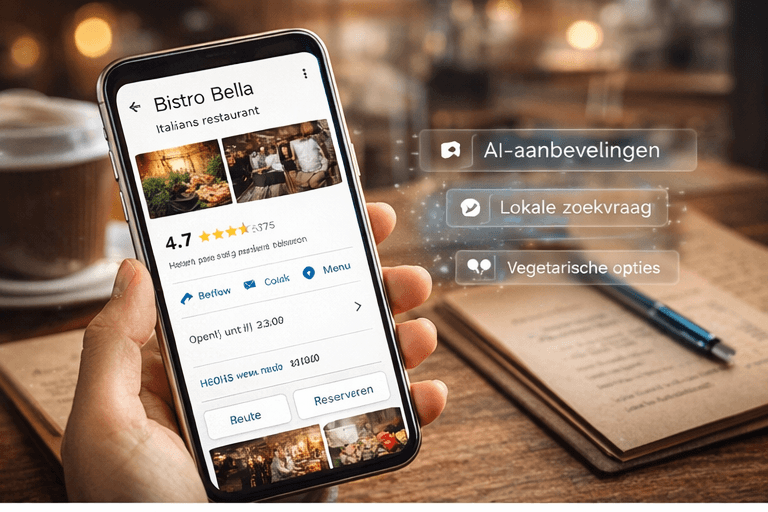
GEO is all about being better understood
The core of GEO is actually simple: not only do you want to be visible, you want to be understood become.
AI doesn't just try to show a list of restaurants. It tries to provide an appropriate answer to a specific question. Therefore, context is becoming more important than ever. Not only what you are, but also for whom, for which time and why someone would choose you.
If your online information does not provide a clear answer to that, an AI fills the gap with information from others - or chooses a competitor who has it in better order.
Where do you start as a hospitality entrepreneur?
Fortunately, the first step is not complicated. Look critically at what a potential guest sees and understands about you online.
Ask yourself:
-
Is it clear on my website what occasions we are suitable for?
-
Do I answer real guest questions?
-
Is my Google Business Profile complete and up to date?
-
Do I have reviews that are specific enough?
-
Will I be mentioned outside my own website?
-
Is my information consistent throughout?
Those who start doing so today will not only build better AI visibility, but also a stronger online position in general.
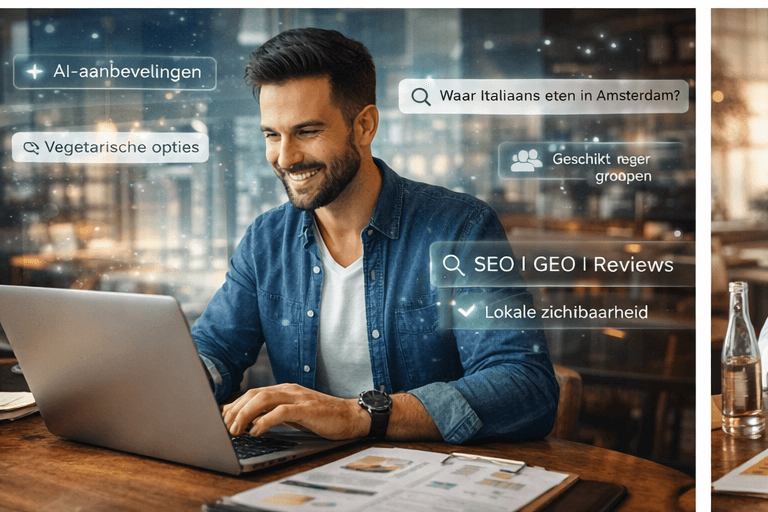
GEO is important, but SEO remains the foundation
And that is perhaps the most important conclusion: GEO is no substitute for SEO.
Indeed, without a good SEO foundation, GEO becomes a lot more difficult. A fast website, clear pages, strong local findability, good content, technical structure and consistent company information remain essential. In many cases, AI actually builds on these.
So don't think of it as a switch from SEO to GEO, but as a development where both are increasingly coming together. SEO makes sure your online foundation is right. GEO increases the chances that you will then also be included in AI's answers.
For hospitality entrepreneurs, this means only one thing: those who invest in both now not only increase their chances of being found in Google, but also of being recommended in the tools that more and more guests use every day.


