






Let’s be honest. Whether you run a restaurant or a hotel, you know the drill by now: the LinkedIn messages, the cold calls and the invitations to demos.
For your restaurant: AI chatbots that take your bookings, AI that posts on your social media, responds to your reviews and generates your menu. For your hotel: AI revenue management that “automatically” optimises your room rates, AI concierges, AI booking assistants and upselling tools that try to sell every guest an extra breakfast or a late check-out. And underlying almost every message is the same underlying message:
“Get on board now, or you’ll fall behind. Your competitor has already overtaken you. Soon, your guests won’t be able to find you anymore.”
It’s a clever sales tactic. Because it strikes exactly the right chord: nobody wants to be the business owner who misses the boat. But before you overhaul your marketing budget out of fear, we’d like to ask the question that almost nobody asks: are your guests really already using AI on that scale to choose a place to eat or stay?
We’re firmly rooted in the hospitality industry every day and can see the difference between what’s being said about technology and what guests actually do. In this article, we’ll set the hype against the figures. For your restaurant and for your hotel. Not to dismiss AI – after all, we use it ourselves every day – but to help you distinguish between a genuine shift and a well-packaged sales pitch.
What people actually use AI for today
Let’s start with what we do know with some certainty: what people are currently using AI for. There is now a great deal of reliable data available on this.
In 2025, OpenAI published one of the largest studies ever conducted into consumer use of AI, based on hundreds of millions of weekly users and billions of messages. The findings are surprisingly unspectacular, and that is precisely the point. Almost 80 per cent of all usage falls into three categories: practical advice, information retrieval and writing. Within this, writing is the largest application. No science fiction, but practical applications such as drafting texts, summarising, rephrasing and brainstorming.
The Anthropic Economic Index, which anonymously analyses how people use the AI model Claude, paints a similar picture with one clear outlier: programming. Coding is by far the largest single application, followed by writing and analysis. Behind-the-scenes business use relies even more heavily on automation and software development.
Other studies confirm this pattern. Pew Research found that a large majority of Americans regularly come into contact with AI, often without realising it, through search engines, navigation systems and voice assistants. In the workplace, this mainly involves writing tasks, data analysis and calendar management.
The common thread? The largest and most mature adoption of AI is in internal processes and productivity. People use AI to work faster, not to decide where they’re going to eat tonight or which hotel to book next month. Bear that in mind, because that’s exactly where you, as an entrepreneur, stand to make the most profit. We’ll come back to that in a moment.
The reality, or rather, this is how guests find you today
So how will guests actually discover a restaurant or a hotel in 2026? We don’t need to guess here either. The channels vary by segment, so we’ll look at them individually.
In your restaurant
Google remains the undisputed driving force behind restaurant discovery. Depending on the study, roughly six in ten diners find new restaurants via Google Search and Google Maps. The vast majority use online sources to choose where to eat, with some studies putting the figure at around 94 per cent. “Best lunch nearby” – a quick look at the menu, the photos, the opening hours and, above all, the reviews.
Reviews remain the cornerstone of trust. Research consistently shows that around 88 per cent of guests take online reviews just as seriously as a personal recommendation. A strong reviews page with recent, replied-to reviews does more for your occupancy rates than any chatbot ever could. Furthermore, Instagram and TikTok tend to be at the forefront of the search process, with that one post popping up in your feed, whilst Google and reviews more often serve as confirmation. And then there’s the channel that can’t be measured by any dashboard: word-of-mouth and the guest who returns simply because they had a good experience last time.
At your hotel
The situation is different for hotels, but the pattern is surprisingly similar: the established channels dominate. Online travel agencies, such as Booking.com and Expedia, account for around 55 per cent of the booking market, with two major groups controlling the lion’s share of that. In addition, comparison sites such as Google Hotels, Trivago and TripAdvisor remain crucial platforms for discovering accommodation.
A Skift overview of the sources travellers use clearly illustrates the ranking: search engines at the top, at around 46 per cent, followed by review sites, at around 36 per cent, recommendations from friends and family, at around 35 per cent, the hotel’s own website, at around 31 per cent, and OTAs, at around 28 per cent. Social media plays a role primarily during the inspiration phase, influencing the choice of destination rather than the specific hotel. And just as with restaurants, reviews and word-of-mouth form the foundation of trust. An additional factor is that a direct booking via your own website is generally more valuable than an OTA booking, simply because you do not have to pay a commission of 15 to 25 per cent on it.
What about AI?
It does exist, and it’s on the rise. But the figures call for a level head and a careful reading.
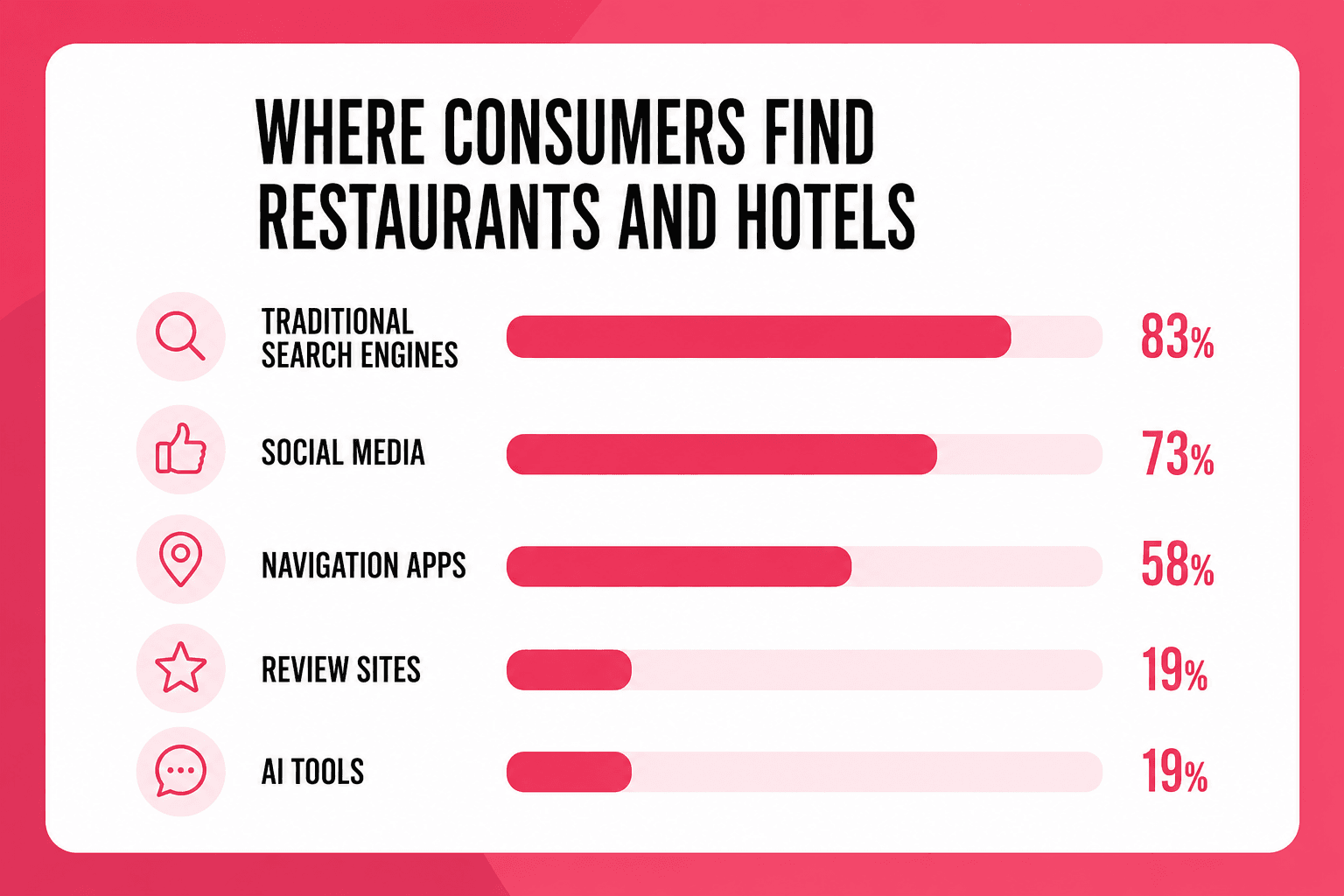
For restaurants, SOCi’s Consumer Behaviour Index 2025 paints a fragmented picture: 83 per cent of consumers still use traditional search engines, 73 per cent use social media, 58 per cent use navigation apps, and both review sites and AI tools account for around 19 per cent. A study by Reputation in collaboration with Nielsen arrives at similar figures: Google Search tops the list at 56 per cent, social media at around 26 per cent, review sites at around 24 per cent and AI tools such as ChatGPT at around 20 per cent.
Higher figures are being cited for travel. The booking platform Travala, for example, claims that by 2025 around 40 per cent of travellers will have used AI tools when planning a trip. Pay close attention to that wording. Using AI to plan a trip – for ideas on a destination, a draft itinerary or a packing list – is something entirely different from booking a hotel via AI rather than via Booking. The step from inspiration to the actual booking is still almost always taken via the familiar channels.
One in five, or even four in ten, is no small matter. AI has gone from virtually zero to a measurable phenomenon in two or three years, and that’s incredibly fast. But “a measurable channel” and “your guests can no longer find you without an AI tool” are two completely different claims. The first is true. The second is, based on current data, simply an exaggeration.
Two points that most sales pitches fail to mention. Firstly: virtually all these figures come from the United States or are global averages. Adoption rates in Europe – and certainly in the Netherlands and Flanders – generally lag behind. For your local guest or your European booking agent, the proportion of AI usage is likely to be lower than these percentages today. Secondly: these studies measure different things, using different methods, and often contradict one another. That’s no reason to ignore them, but it is a reason to be wary whenever someone presents you with a single spectacular figure as proof that you must pay right now.
The bottom line: visibility is not the same as adoption
We believe this is where the fallacy lies. There is a significant gap between perception (“everyone uses AI for everything”) and reality (“people use a smart assistant for everyday tasks”). And this is down to a familiar mechanism.
AI companies talk about it non-stop. LinkedIn is full of it. Consultants are pitching it as an urgent transformation. And software companies are rapidly repositioning their existing products around AI.
The result is a psychological effect whereby you confuse visibility with adoption. Because you read about it everywhere, it feels as though everyone is using it for that purpose everywhere. But talking a lot about something is not the same as it being used on a massive scale in the way that is suggested.
Why AI marketing is making such a big fuss
That brings us to the question of why the message sounds so compelling. The answer is not a conspiracy. It’s simply economics.
The market for hospitality and hotel software is fiercely competitive. Dozens of providers are vying for the same business owner, with products that are virtually indistinguishable to the average guest. In such a market, a sense of urgency is the most powerful sales tool there is. “This might be useful” is a slow seller. “You’ll miss out on guests if you don’t use this” is what sells today.
You can see this reflected in how the figures are presented. One widely shared restaurant statistic claims that 45 per cent of consumers now use AI for local recommendations, a jump from 6 per cent a year earlier. It’s not a made-up figure, but it is significantly higher than what most other studies show, and it’s being bandied about most vigorously by parties who, coincidentally, sell AI visibility services. The same applies to that 40 per cent travel figure: it comes from a platform that itself offers AI-powered bookings. That doesn’t make the figures untrue, but it should keep you on your toes. Anyone citing a figure sometimes has a vested interest in ensuring it’s convincing.
And there is a real, structural force driving this urgency: there is money to be made from your visibility. In early 2026, OpenAI introduced adverts into ChatGPT. And in the hospitality sector, things went a step further: Booking.com and Expedia linked their systems directly to OpenAI’s AI, enabling travellers to search for and book a hotel through conversation. That’s no minor detail. It shows that “AI bookings” are, in practice, often simply a new shop window on top of the same OTA data. Not a mysterious new channel that replaces everything, but a new shop window for the shop where you were already standing.
None of this is a cause for cynicism. Software developers and platforms are simply doing their job, and some tools are genuinely good. But it explains why the tone of the message is so much more alarming than the underlying data warrants. Your task is not to mistrust every salesperson, but to recognise the difference between their interests and your own.
The lesson from previous hypes
We’ve seen this trick before. Over the past few years, we’ve seen a whole host of technologies come and go, all of which were heralded as inevitable and world-changing.
Clubhouse, the audio app, exploded in popularity during the pandemic and was briefly hailed as the future of social media, only for its usage to plummet just as quickly. NFTs were touted as the reinvention of ownership and art, with huge sums of money and accompanying headlines, only to largely fade from view. The metaverse was set to become the way we meet and even hold meetings. So far, the billions invested have mainly yielded disappointing usage figures.
The lesson is not that new technology is always nonsense. The lesson is that the speed of adoption is almost always overestimated, even if the technology ultimately proves to be valuable.
The QR code is the finest example of this, and in our sector of all places. For years, it was dismissed as a failed gimmick. Then came the pandemic, and the technology suddenly became mainstream at lightning speed for digital menus, contactless check-in and ordering at the table. Not because a salesperson told you you were lagging behind, but because a genuine, practical reason emerged as to why guests wanted to use it.
That’s another way of looking at AI. The question isn’t whether the technology is here to stay – it probably is. The question is at what pace, in what form, and whether it’s already helping your guests find your business today. And the honest answer to that last question is: only to a limited extent for the time being.
Where AI is already saving you time and money
And this is where it gets interesting. Because whilst the use of AI by your guests is still limited, the use of AI to benefit you as a business owner is already incredibly valuable today. And that ties in perfectly with what we saw in Part 1: the real power of AI lies in internal processes and productivity.
A few applications that are already paying off, for both worlds:
- Social media content. Captions, content ideas, a monthly schedule, variations on an announcement or offer. AI makes the process a lot easier, so you can keep posting consistently rather than letting it fizzle out.
- Replying to reviews. A well-thought-out, personalised response to every review – whether it’s on Google, TripAdvisor or in your Booking inbox – takes time that you often don’t have. AI provides a strong first draft that you can adapt to your own tone in a matter of seconds.
- Email campaigns and guest communications. From newsletters and loyalty campaigns to, for hotels, pre-arrival emails, upsell offers and post-stay follow-ups. Quicker to set up, easier to customise and test.
- Multilingual communication. For hotels with international guests: confirmations, house rules and replies in multiple languages, whilst maintaining your own tone.
- Staff handbooks and work instructions. Opening and closing procedures, allergen policy, housekeeping and reception SOPs, onboarding of new staff. A bit of a chore to write, but perfect for structuring with AI.
- Generating marketing ideas. Struggling to find inspiration for a campaign during a quiet month or in the off-season? AI is an excellent sparring partner for putting forward twenty different angles, from which you can choose the two best ones.
- Documenting operational knowledge. Turning the knowledge currently held in the minds of your boss, operations manager or front-office manager into clear documentation.
In all these cases, AI is not a customer acquisition channel, but a tool for improving efficiency. It lowers the barrier to doing the things you had to do anyway, and does them better, more consistently and faster. This is exactly the sort of support we believe in: you focus on your guests, whilst the technology works for you in the background.
And there’s a clear logic to it. The signals that make you stand out in AI results are largely the same fundamentals that have always mattered: accurate, complete listings on Google and the OTAs, strong photos, a steady stream of recent reviews, authentic content and a name that people are talking about. Various analyses of how chatbots recommend restaurants and hotels consistently point to these same signals. In other words: by getting your basics right, you’re automatically preparing for an AI-driven future. You don’t need an expensive, separate “AI strategy” for that. You simply need to do your job well.
Conclusion: no fear, but sharpness
All things considered, AI represents a genuine technological shift, and its use for discovering places and planning trips is growing – even faster than some previous trends. It would be short-sighted to deny that. But the data today is crystal clear on the ranking: Google, reviews, social media, OTAs and word-of-mouth still account for by far the largest proportion of your guests. AI is an emerging channel, not a dominant one. And certainly not in the current European market.
So there’s no need to panic. Your guests aren’t going to disappear in droves just because you didn’t install an AI booking bot or AI concierge last month. The best approach isn’t to chase after every new AI solution that comes along, but to implement the marketing and operational strategies that are already working more intelligently and consistently. And, above all, let AI be a useful tool to help you do just that.
Be curious about technology. Experiment with it wherever it makes your work easier. Keep your listings, photos and reviews in order, as this pays dividends on every channel, including tomorrow’s AI channel. But let your decisions be guided by what your guests do, not by what someone is trying to sell you.
Ultimately, it all comes down to one question: are you using AI for something that your guests actually value?
The Fully Bookers is a marketing agency specialising in the catering and hospitality sectors. We help restaurants, hotels and hospitality groups maximise their occupancy rates by cutting through the noise and investing in what has been proven to work. Full house, high and low season.
A note on the figures: the percentages cited are taken from a variety of studies, including those by OpenAI, Pew Research, SOCi, Reputation/Nielsen, Skift, Travala, BrightLocal and various OTA analyses, using different methodologies, target audiences and countries, predominantly the United States and global averages. They indicate a general trend, not an exact truth, and vary in certain respects. That is precisely why we advise reading each individual figure with a healthy dose of scepticism, particularly when the person presenting it has a vested interest.


